Phone Call OSINT: Deconstructing a Transcript to Solve Sofia Santos Exercise 19
Bu çözümün Türkçesi de var: sağ üstten dili TR yapın.
TL;DR: By analyzing a fictional one-sided phone transcript from Sofia Santos Exercise 19, we narrow down the search area from national language policies to an inland water hub in Belgium, evaluate a compelling false positive in Brussels, and locate the strongest candidate: Moskee OKBA IBN NAFI in Gent (51.0565, 3.7381).
Tools Used
- Google Maps & Street View
- Numbeo Crime & Safety Index (Historical 2023)
- Belgian National Rail (SNCB) Timetables
1. Scenario Analysis & Key Briefing Clues
Sofia Santos Exercise 19 provides a transcript of a one-sided phone conversation dated July 22, 2023. While the narrative is fabricated, the physical setting described is real.
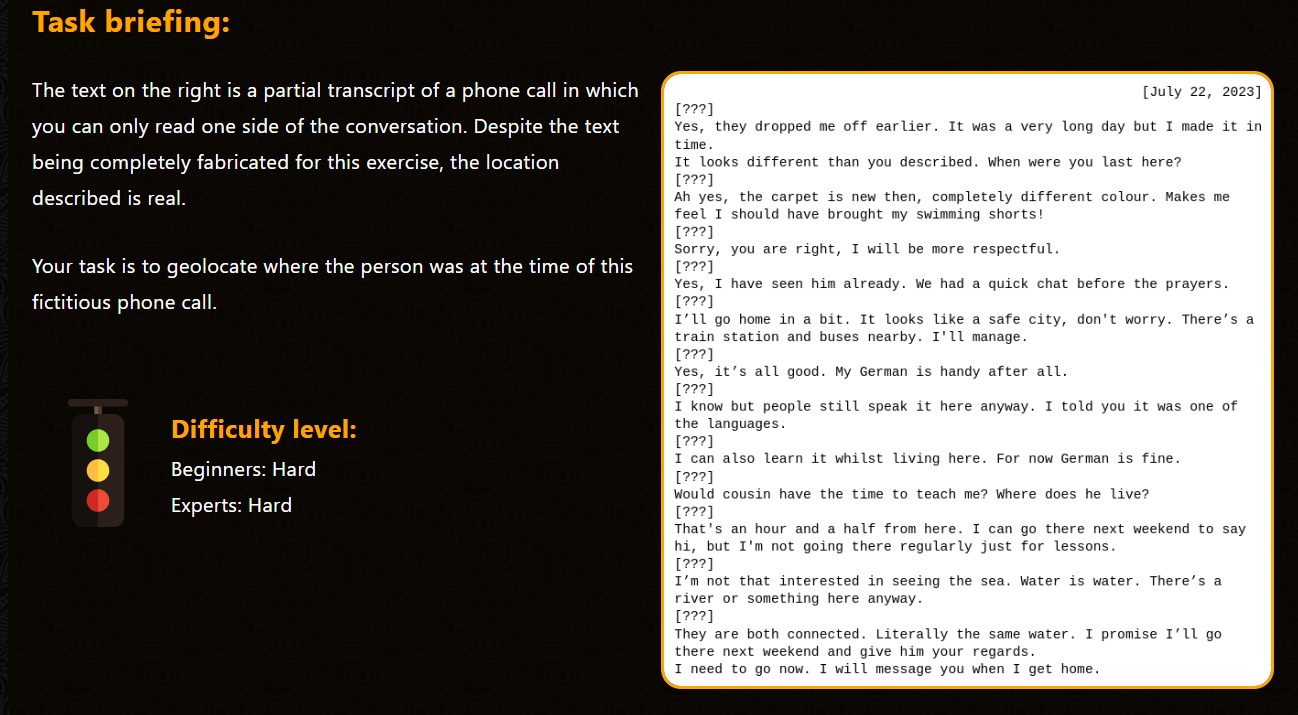
Key data points extracted from the transcript:
- Date & Seasonality: The call is dated July 22, 2023. The casual reference to swimming shorts and summer mobility points toward a region experiencing midsummer, excluding Southern Hemisphere locations where July corresponds to midwinter.
- The Setting & Interior Clues:
“Ah yes, the carpet is new then, completely different colour. Makes me feel I should have brought my swimming shorts! Sorry, you are right, I will be more respectful. Yes, I have seen him already. We had a quick chat before the prayers.”
- The mention of prayers, an explicit carpet replacement reminiscent of pool water, and the immediate reminder to be respectful indicate a mosque or prayer room (masjid) with bright turquoise or light-blue carpeting.
- Transit Infrastructure:
“There’s a train station and buses nearby. I’ll manage.”
- The venue is located within walking distance of an operational railway terminal and local bus connections.
- Safety Remark:
“It looks like a safe city, don’t worry.”
- Linguistic Ambiguity:
“My German is handy after all... I told you it was one of the languages. I can also learn it whilst living here. For now German is fine.”
- German serves as an official national language, but it is explicitly not the sole or primary everyday tongue spoken locally.
- Water Connection to the Coast:
“I’m not that interested in seeing the sea. Water is water. There’s a river or something here anyway... They are both connected. Literally the same water.”
- The speaker’s cousin lives roughly 1.5 hours away near the coast, while the caller sits alongside an inland river or connected waterway that discharges into that same sea.
2. Country-Level Elimination
Applying the linguistic, seasonal, and maritime criteria narrows down the options:
- Monolingual German-Speaking Countries (Germany, Austria): The speaker specifically notes that German is merely “one of the languages” and plans to learn the local tongue while living there. This eliminates Germany and Austria, where German is the sole predominant national language.
- Landlocked Multilingual Nations (Switzerland, Luxembourg, Liechtenstein): While Switzerland recognizes German alongside French, Italian, and Romansh, it is completely landlocked. Reaching an open sea coast in roughly 90 minutes from inside Switzerland or Luxembourg is geographically impossible.
- The Logical Candidate (Belgium): Belgium recognizes three official languages: Dutch, French, and German. Crucially, Belgium borders the North Sea to the west, and reaching coastal resorts from central inland water cities typically requires between 60 and 90 minutes by rail or road. This establishes Belgium as the primary candidate country.
A realistic linguistic note: In Flanders (Dutch-speaking northern Belgium), German is rarely used in daily life. The caller’s remark that their German is “handy” serves as an overarching macro-level clue pointing to Belgium (where German is an official language in the East Cantons), rather than a reflection of local spoken language in the target city itself.
3. The Brussels Trap: A Believable False Positive
Initial searches for Belgian mosques near transit hubs and water corridors revealed a striking candidate in northern Brussels: Bruxelles Ulu Camii, located near Brussels-North (Gare du Nord).
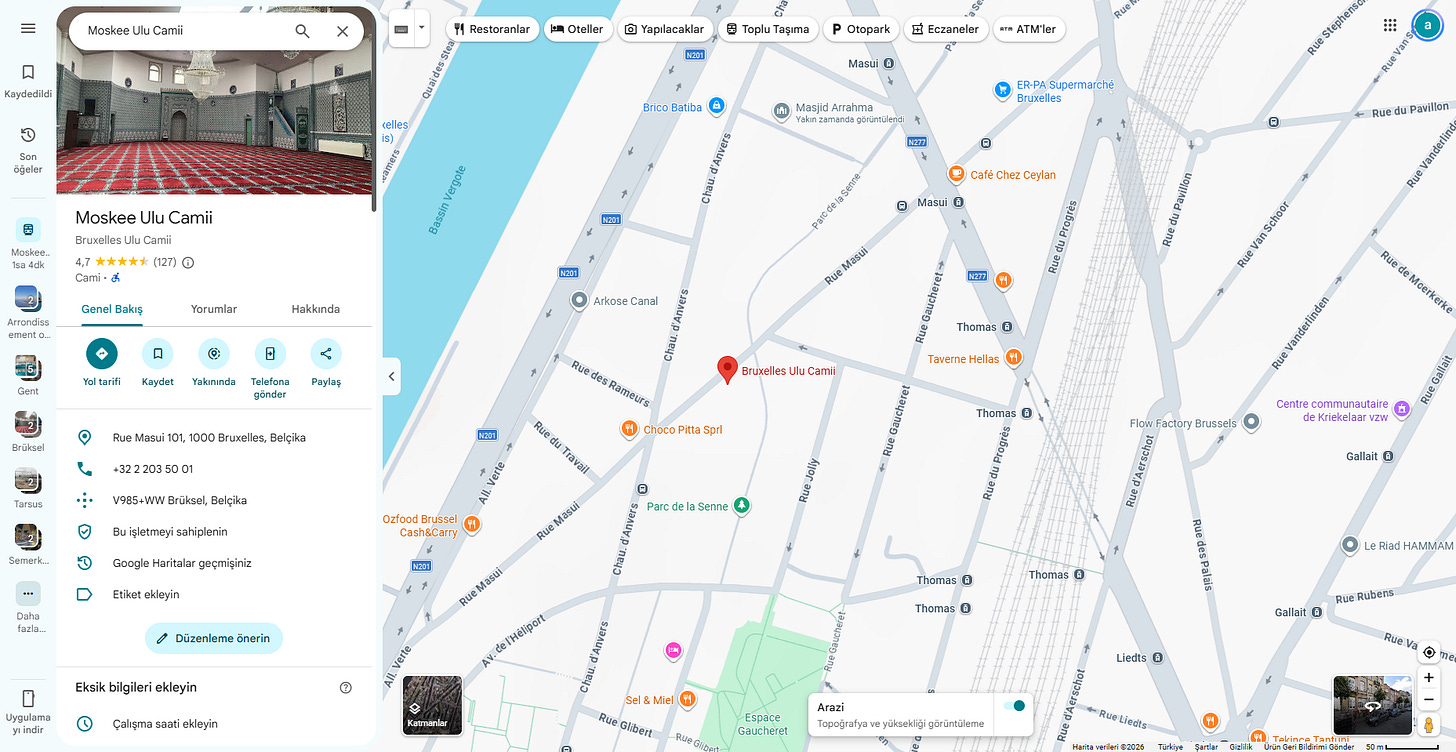
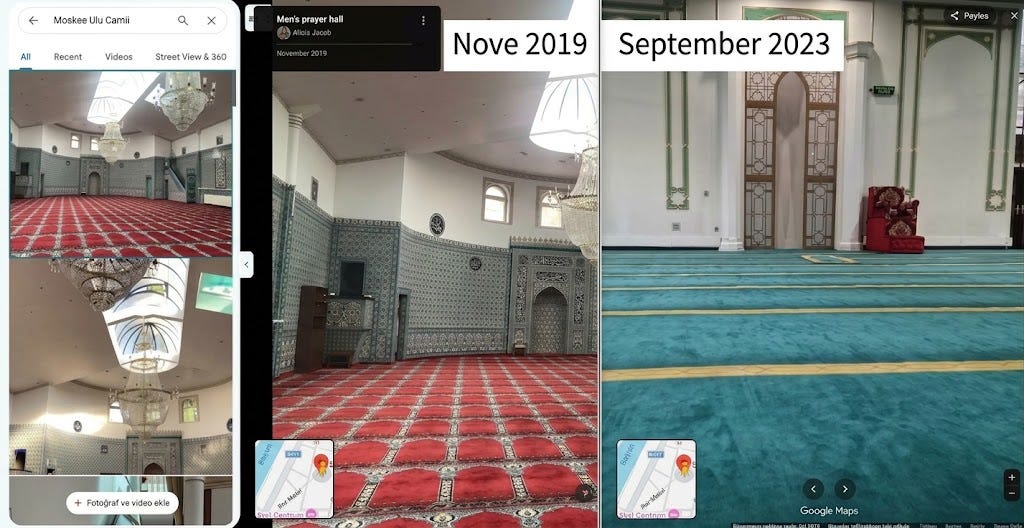
Archived imagery confirmed a dramatic interior renovation: traditional crimson-red carpets had been replaced with a vibrant, pool-blue carpet.
While visually compelling, several contextual factors weakened Brussels as the target:
- Waterway Classification: The waterway bordering the mosque is an artificial commercial shipping basin (Bassin Vergote / Brussels–Scheldt Maritime Canal), whereas the speaker informally notes a “river or something”.
- Safety Context: The area around Brussels-North is known for elevated petty crime. Describing Brussels as an unambiguously “safe city” felt inconsistent with typical OSINT exercise design.
- Timeline Verification: The public Google Maps upload showcasing the turquoise carpet at Ulu Camii dates to September 2023. While the physical carpet installation could predate the upload, treating an unconfirmed upload date as proof of a July 2023 state introduces investigative bias.
Ultimately, Brussels could not be definitively ruled out on carpet imagery alone, but the cumulative context suggested looking for a city with a stronger environmental match
4. Regional Filtering via Numbeo Safety Statistics
To evaluate the caller’s remark (“It looks like a safe city, don’t worry”), we examined Numbeo’s Safety Index by City 2023 for Belgium.
(Note: The 2023 historical table on Numbeo listed only four Belgian cities with sufficient published data: Gent, Antwerp, Brussels, and Liege).
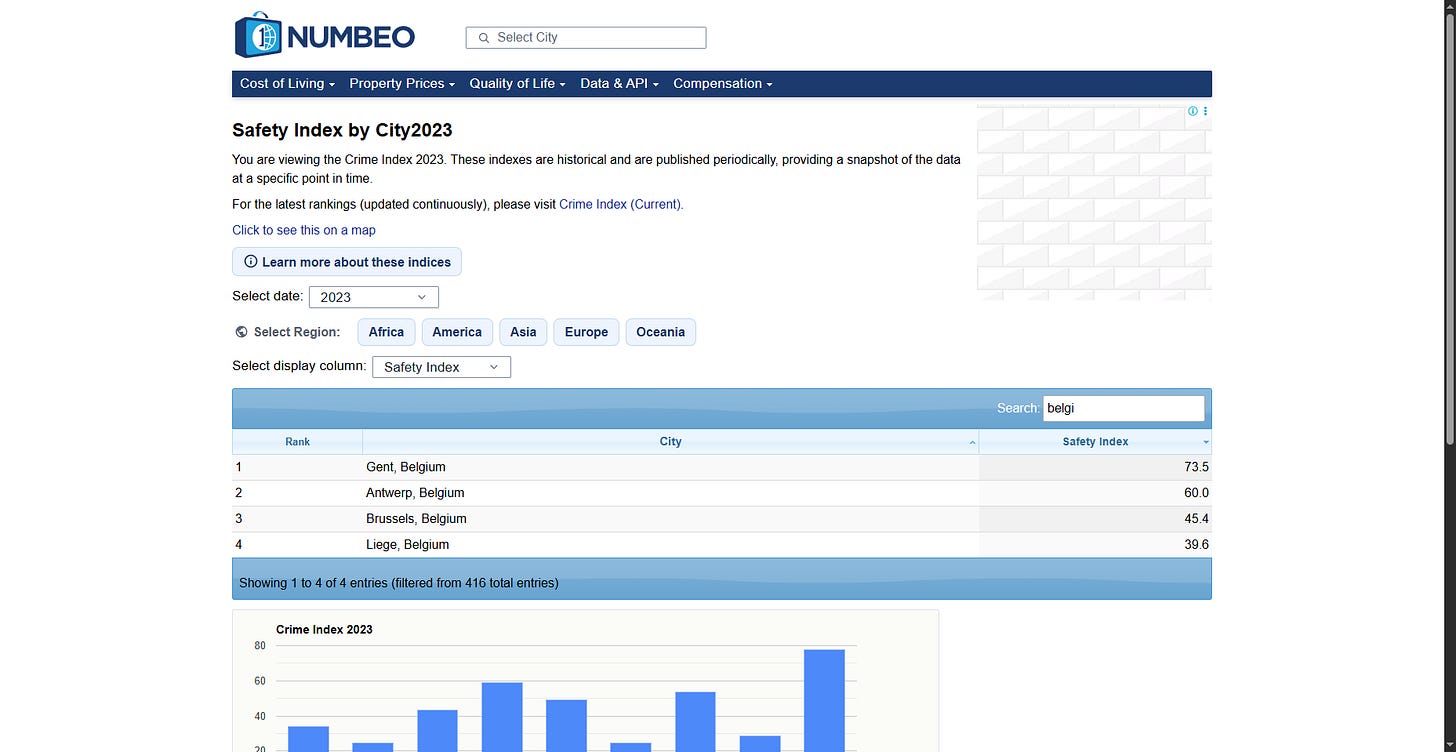
- Gent: 73.5 (Ranked #1 safest city in Belgium)
- Antwerp: 60.0
- Brussels: 45.4
- Liege: 39.6
While crowd-sourced indices are not absolute proof, the contrast is informative: Brussels ranks near the bottom, while Gent leads the evaluated cities by a substantial margin.
Geographically, Gent aligns well with the majority of the constraints:
- Hydrology: Gent sits at the natural confluence of the Leie and Scheldt rivers. Through canalized sections and the Ghent-Terneuzen maritime canal, these inland waters flow northward into the Western Scheldt estuary and the North Sea, matching the phrase “Literally the same water”.
- Transit Time to the Coast: According to SNCB timetables, traveling from Gent to coastal destinations such as Oostende, Blankenberge, or Knokke-Heist takes roughly 50 to 85 minutes by train, fitting reasonably well with the caller’s informal “hour and a half” estimate.
5. Micro-Location Filtering: Mosques of Gent
Gent has two primary railway stations: Gent-Sint-Pieters (the main intercity terminal) and Gent-Dampoort (the secondary eastern station).
While both areas were checked, the neighborhood around Gent-Dampoort presented a much stronger immediate concentration of multi-modal transit (rail and regional bus bays) directly adjacent to an open water basin (Achterdok / Handelsdok)
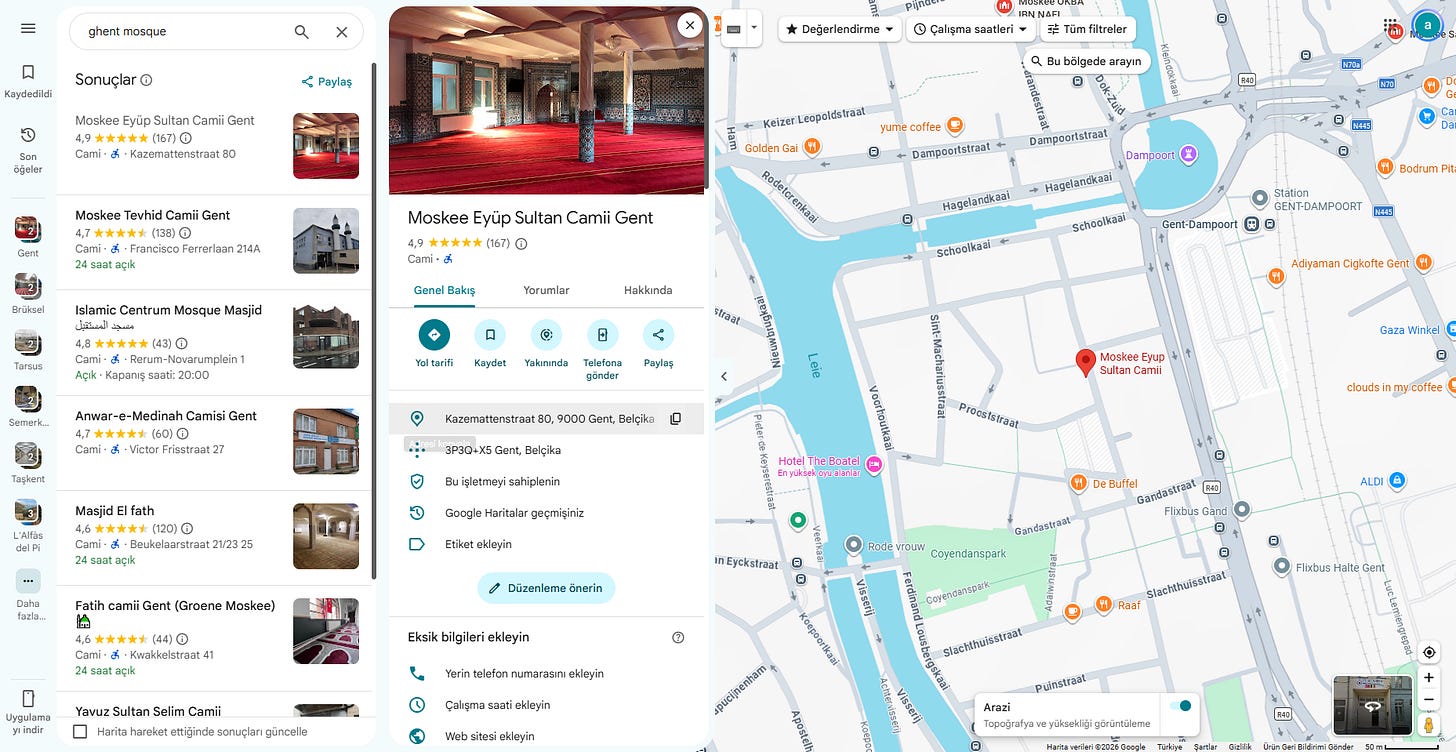
Examining the mosques within walking distance of Dampoort:
- Moskee Eyüp Sultan: Located south of the station on Kazemattenstraat, interior photos show traditional deep-red carpeting, failing the color clue.
- Peripheral Mosques (e.g., Masjid El Fath, Tevhid Camii): Located further into residential quarters, away from the direct station-and-water corridor.
Focusing on the western edge of the Achterdok basin brings us to Warandestraat:
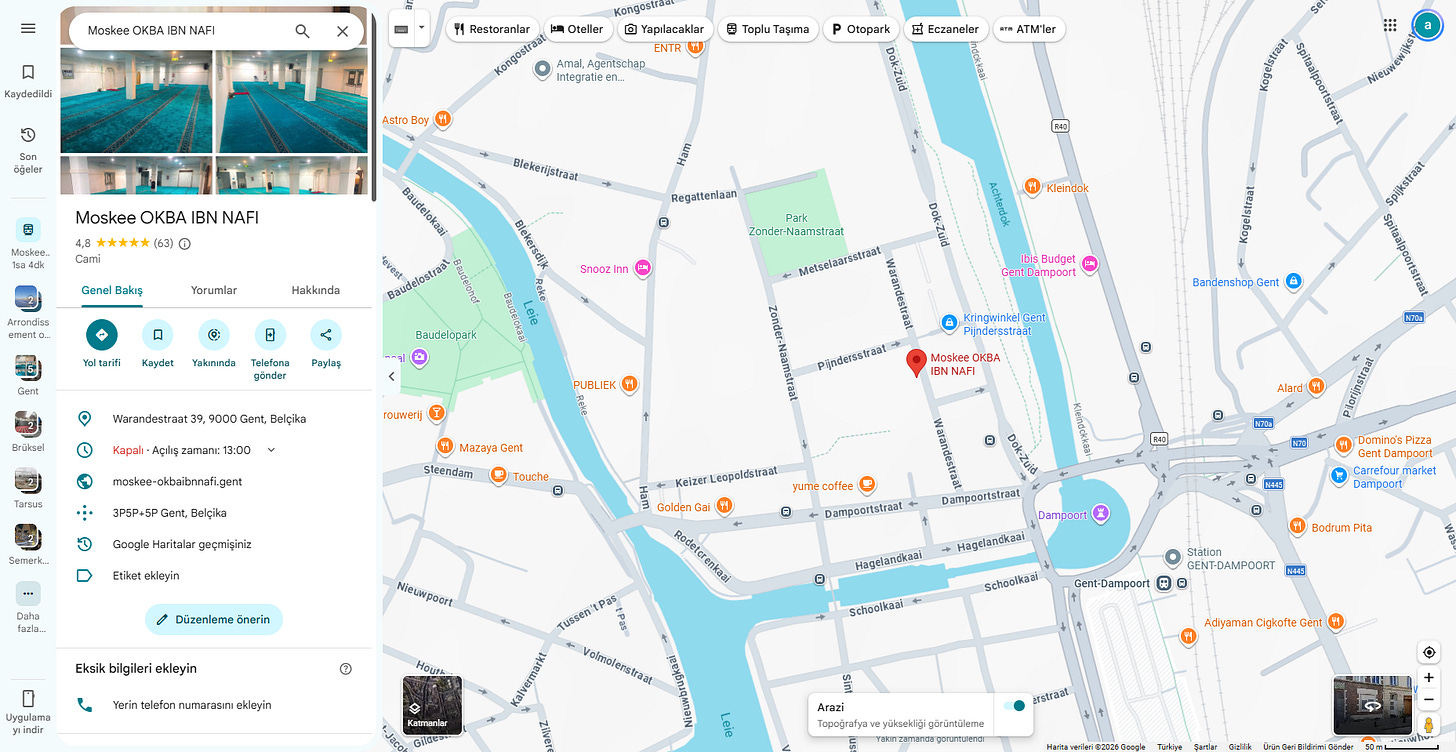
- Target Facility: Moskee OKBA IBN NAFI (Warandestraat 39, 9000 Gent, Belgium)
- Interior Carpet: Google Maps photos show a bright aquatic turquoise-blue carpet throughout the prayer hall, closely mirroring the “swimming shorts” joke. (Methodological note: As with the Brussels candidate, Google Maps imagery does not provide a definitive timestamp proving this carpet was installed specifically before July 22, 2023. The Gent solution is not based on a single timestamped photo, but on the convergence of multiple constraints—safety rankings, transit proximity, and river-to-sea hydrology).
- Transit Distance: The building is located approximately 270 meters northwest (straight-line) or a 350-meter walk from the Gent-Dampoort platform entrance and bus interchange.
- Water Connection: It is positioned right along the Achterdok basin, which connects into the Ghent maritime canal network leading to the sea.
Key Takeaways
- Avoid Over-Relying on a Single Match: Bruxelles Ulu Camii presented an almost identical carpet renovation, but Gent offered a more consistent match when layering safety perceptions and hydrological context.
- Differentiate Macro vs. Micro Clues: The German language reference was an indicator of the country (Belgium’s trilingual status), rather than the everyday spoken language of the specific city.
- Be Transparent with Timeline Limits: Public crowdsourced photos rarely come with certified installation dates; recognizing this limitation prevents confirmation bias.
Final Coordinates
- Location: Moskee OKBA IBN NAFI
- Address: Warandestraat 39, 9000 Gent, Belgium
- Coordinates:
51.0565, 3.7381
Connect with Me
- LinkedIn: alpakciger
- GitHub: alpakciger
- Substack:alpakciger
Originally published on Substack