OSINT Exercise #015 Walkthrough: Declassified CIA Records & Historical Geolocation
Bu çözümün Türkçesi de var: sağ üstten dili TR yapın.
A special thanks to Sofia Santos (Gralhix) for designing this challenging and educational historical OSINT exercise.
The Challenge Overview
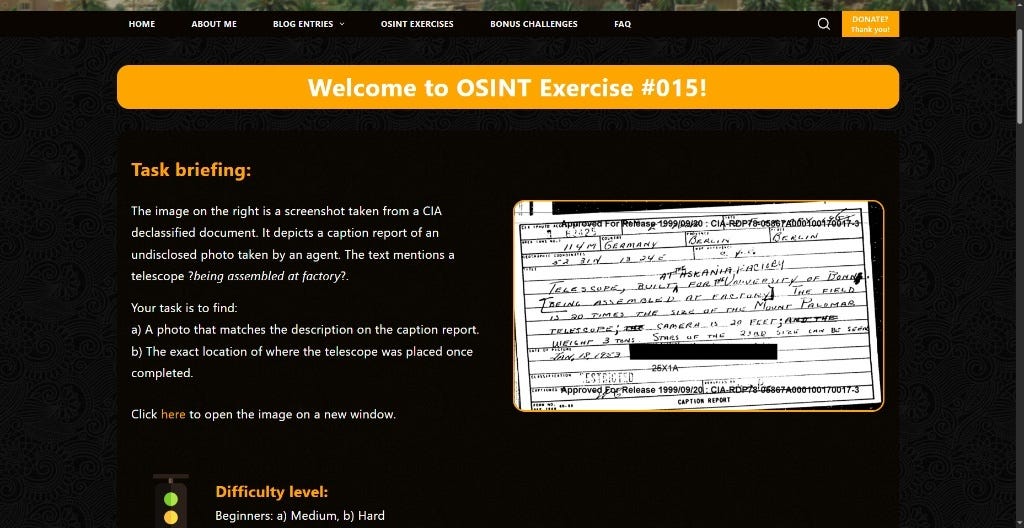
Sofia Santos’s OSINT Exercise #015 presents a screenshot of a declassified CIA Caption Report documenting an undisclosed photograph taken by an intelligence agent in January 1953.
The Objectives:
- Find the original photograph referenced in the CIA caption report.
- Determine the exact final location where the telescope was installed once completed.
Step 1: Deconstructing the CIA Caption Report
The first step was extracting all actionable metadata from the report card:
- Manufacturer:
AT ASKANIA FACTORY(Askania-Werke, a prominent German optical and precision instrument maker located in Berlin). - Target/Client:
BUILT FOR THE UNIVERSITY OF BONN. - Technical Specs: Camera size of 20 feet, 3-ton weight, optical field 20x larger than the Mount Palomar telescope.
- Stage/Context:
being assembled at factory(Indicates the photo was taken inside a manufacturing workshop, not an observatory dome). - Date of Intelligence:
JAN, 18, 1953. - Report Origin: Berlin, Germany.
Step 2: Querying the CIA FOIA Database
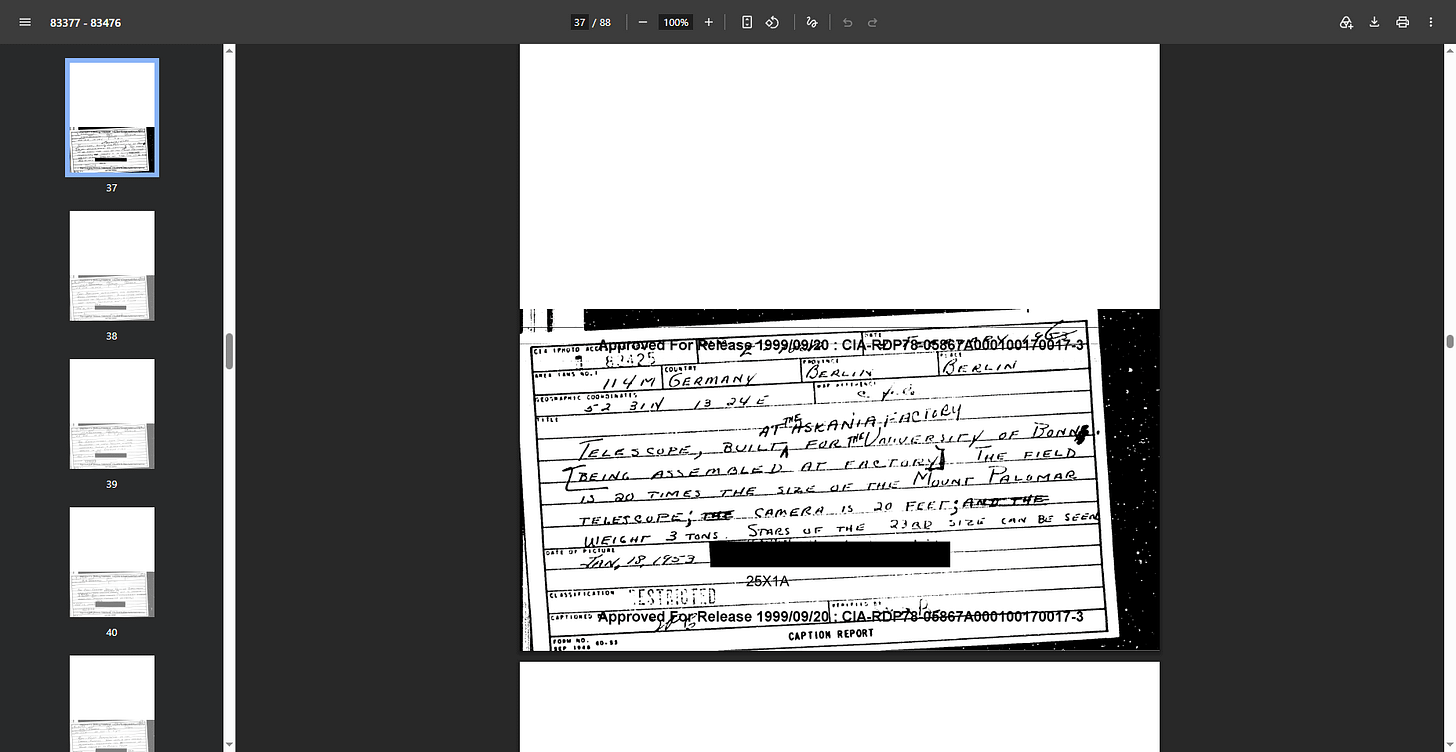
To verify the document index and examine full records, I queried the CIA Freedom of Information Act (FOIA) Electronic Reading Room using the document identifier CIA-RDP78-05867A000100170017-3.
This search directly retrieved the declassified FOIA PDF containing the collection of Ground Photo Caption Cards from the era.
Step 3: Finding the Photograph (Task A)
Standard web searches for historical telescopes often default to modern, high-resolution photos of operational domes. However, the CIA document specifically emphasized the assembly stage inside the workshop.
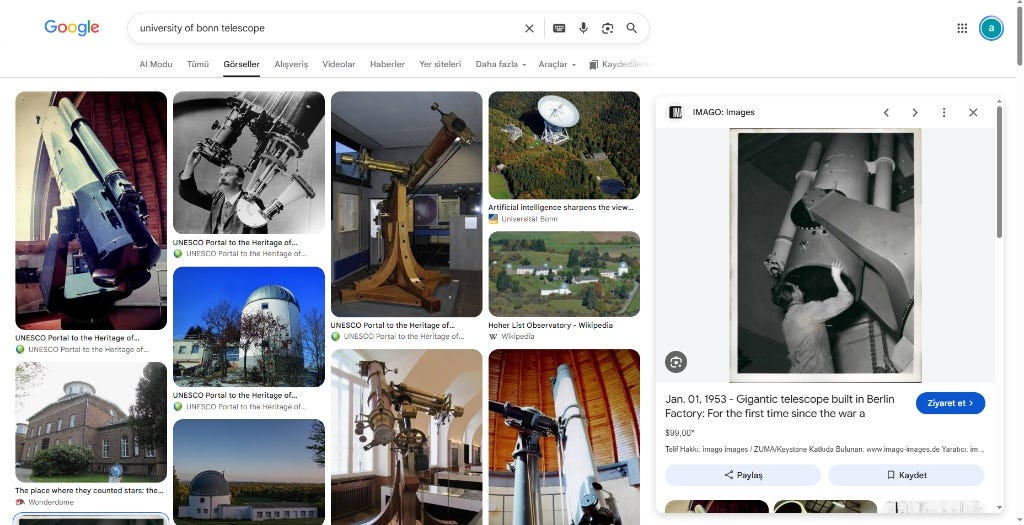
Using the query university of bonn telescope, I began cross-referencing visual records with historical press archives.The search surfaced the exact black-and-white press photograph:
- Subject: A technician in a workshop coat actively assembling the internal mirror/aperture.
- Background: Industrial workshop ceiling beams and a heavy-duty hoist chain matching the “being assembled at factory” description.
- Archive Reference: IMAGO Images ID
0061895213(“Jan. 01, 1953 - Gigantic telescope built in Berlin Factory...”).
Step 4: Tracking the Final Installation Location (Task B)
With the instrument identified as the Schmidt telescope (Schmidt-Spiegel) commissioned from Askania-Werke by the University of Bonn, the next task was locating its permanent home.
- Historical Context: Due to urban light pollution at the original Alte Sternwarte in Bonn, the university established a dedicated out-of-town observing station in the early 1950s: the Observatorium Hoher List (Hoher List Observatory) near Daun in the Eifel mountain region.
- Installation: Construction began in 1953, and the Askania Schmidt telescope was officially installed in the first completed dome around 1954.
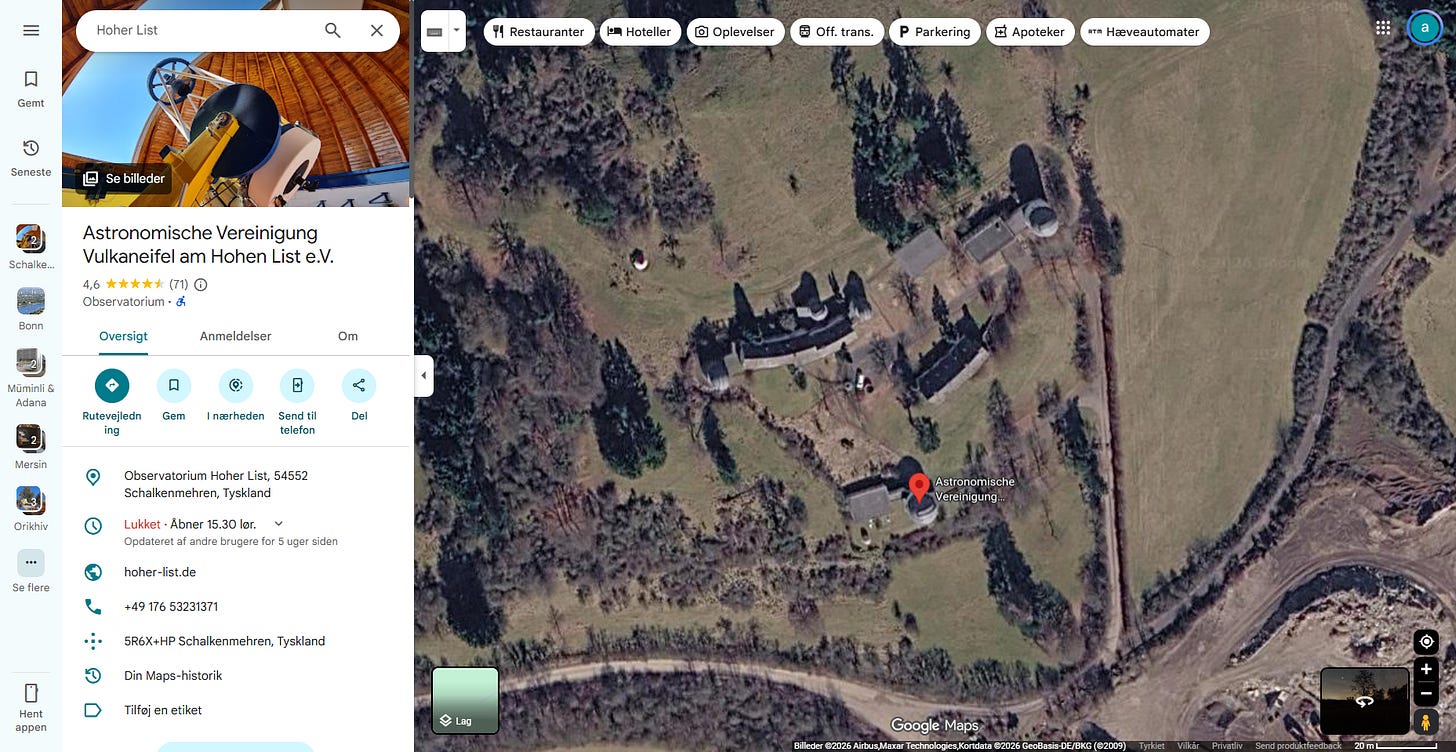
Site: Observatorium Hoher List (Hoher List Observatory)
- Location: Schalkenmehren / Daun, Rhineland-Palatinate, Germany
- Coordinates:
50°09'46"N 6°50'55"E(50.1627° N, 6.8486° E)
Key Takeaways
- Deconstruction First: Parsing every text entity (factory name, client, date, state of assembly) eliminates guesswork before querying.
- State of Assembly: Recognizing the distinction between an operational instrument (in an observatory dome) and one under construction (in a factory workshop) was crucial for filtering out false positive images.
- Archive Precision: Press photo databases often index historical machinery better than modern academic repositories.
Originally published on Substack