Attack Surface Mapping & Brand Integrity Analysis: A Passive OSINT Framework
Bu çözümün Türkçesi de var: sağ üstten dili TR yapın.
Responsible Disclosure & Ethics Note:
In accordance with cybersecurity standards, responsible disclosure practices, and privacy regulations, all corporate entities, specific subdomain strings, and software version identifiers referenced in this case study have been redacted ([REDACTED]). This research relies strictly on 100% passive, open-source metadata. No active network scanning, intrusion, or packet delivery was conducted against target systems.
Executive Summary
In modern digital ecosystems, maintaining visibility over an organization’s external attack surface and protecting brand reputation from typosquatting are critical components of threat intelligence and corporate defense.
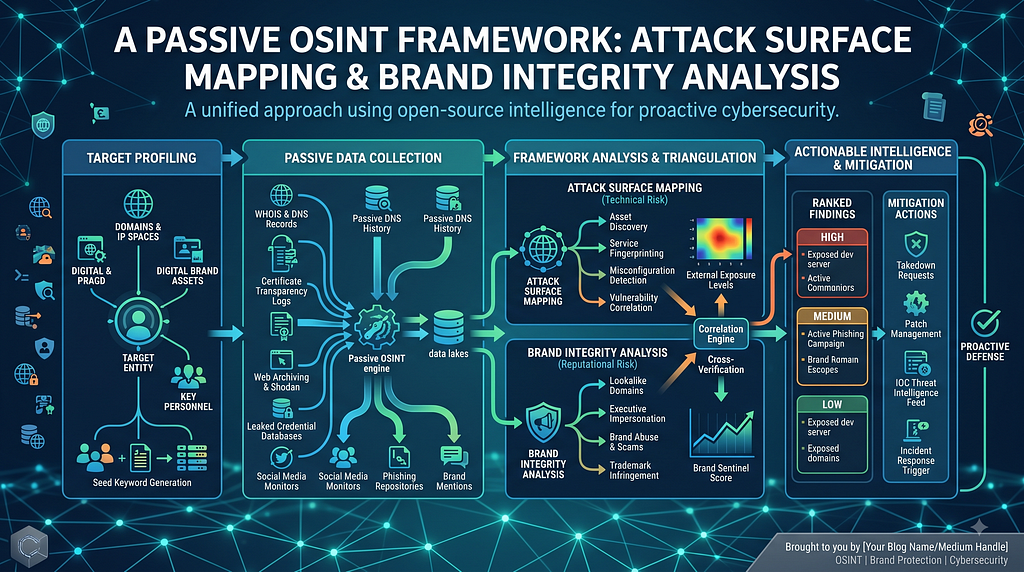
This case study demonstrates a dual-phase passive Open Source Intelligence (OSINT) methodology applied to a European FinTech payment infrastructure. Utilizing Certificate Transparency (CT) logs and passive DNS analysis, this research maps external infrastructure — identifying exposed staging environments and third-party API dependencies — while evaluating potential brand impersonation risks across top-level domain variations.
Phase 1: External Attack Surface Mapping via Certificate Transparency Logs
Methodology
Certificate Transparency (CT) logs provide a public, append-only record of SSL/TLS certificates issued for domain names. By querying public CT repositories (such as crt.sh), an investigator can passively map subdomains, internal environments, and third-party API dependencies without actively scanning or interacting with the target network.
Query Method: Passive CT Log EnumerationTarget Scope: Wildcard SSL Certificate FootprintsTooling: Certificate Transparency Repositories / Passive DNS AnalysisKey Infrastructure Findings & Categorization
Analysis of issued SSL/TLS certificates yielded actionable intelligence regarding operational architecture and supply chain dependencies:
1. Exposed Staging & Quality Assurance (QA) Asset Clusters
Multiple subdomains designated for Quality Assurance (QA) and staging of third-party e-commerce integrations were identified as publicly resolvable:
[REDACTED-CMS-FRAMEWORK-01].qa.[TARGET-DOMAIN].com[REDACTED-CMS-FRAMEWORK-02].qa.[TARGET-DOMAIN].com[REDACTED-ECOMMERCE-STAGE-03].qa.[TARGET-DOMAIN].com[REDACTED-CONTROL-PANEL-04].qa.[TARGET-DOMAIN].comstaging.online.[TARGET-DOMAIN].comRisk Assessment: Publicly resolvable staging instances running legacy Content Management System (CMS) frameworks or administrative panels expose internal architecture to automated reconnaissance. If left unmonitored without IP whitelisting or Zero Trust Network Access (ZTNA), these endpoints present potential entry points for threat actors.
Threat Modeling & Vulnerability Vectors (CVE Mapping Concept)
While passive reconnaissance strictly avoids active vulnerability scanning, exposing specific CMS framework strings within subdomain naming conventions provides threat actors with immediate targets for automated exploit frameworks:
- E-Commerce Plugin Exploit Chains: Legacy or unpatched e-commerce plugin staging instances are historically targeted via Remote Code Execution (RCE) and Arbitrary File Upload vectors.
- Administrative Exposure: Subdomains resolving to administrative endpoints increase exposure to credential-stuffing and brute-force campaigns aimed at control panels.
2. Third-Party Payment & API Ecosystem Mapping
The CT logs exposed dedicated API endpoints interfacing with major global financial technology and infrastructure providers:
- Card Issuing & Core Infrastructure: api.[REDACTED-CARD-ISSUER].[TARGET-DOMAIN].com
- Payment Gateways: [REDACTED-PAYMENT-GATEWAY].[TARGET-DOMAIN].com
- Investment & Wealthtech Integrations: api.[REDACTED-WEALTHTECH].[TARGET-DOMAIN].com
Analytical Takeaway: Passive reconnaissance enables threat intelligence analysts to map supply chain dependencies and third-party integrations purely through open-source digital footprints.
3. Core Operational Infrastructure
Subdomains associated with internal development and communication protocols were also cataloged:
- git.[TARGET-DOMAIN].com (Version Control Repository Endpoint)
- imap.[TARGET-DOMAIN].com / smtp.[TARGET-DOMAIN].com (Corporate Mail Infrastructure)
Phase 2: Brand Integrity & Typosquatting Analysis
Threat Scenario
Malicious actors routinely target FinTech brands by registering domain variations (typosquatting / TLD squatting) to execute credential harvesting, Account Takeover (ATO) scams, or phishing campaigns aimed at mobile wallet users.
Investigation Case: Top-Level Domain Variation Analysis
During infrastructure monitoring, top-level domain variations (e.g., .net derivatives) were subjected to passive resolution analysis.
Historical Subdomain Footprint
Historical certificate issuance logs for the target domain variation revealed standard shared-hosting service structures:
- cpanel.[TARGET-DOMAIN].net
- webmail.[TARGET-DOMAIN].net
- mail.[TARGET-DOMAIN].net
Active Resolution & Scanning (Urlscan.io)
To determine whether the asset was actively serving malicious landing pages or phishing kits, automated headless browser scanning was performed via Urlscan.io.
Target Analyzed: [TARGET-DOMAIN].netScan Result: HTTP 400 / DNS Resolution Error (NXDOMAIN)A/AAAA Record Status: Inactive / UnresolvedStrategic Threat Intelligence Evaluation
The inability to resolve an active IP address leads to three strategic intelligence assessments:
- Defensive Brand Registration: The organization may hold domain derivatives defensively to prevent rogue registration, leaving DNS records unassigned or parked.
- Post-Takedown Inactivity: The domain may have previously hosted infringing content and subsequently underwent hosting termination or administrative takedown.
- Dormant Infrastructure Risk: A dormant domain remains an asset of interest. Continuous passive DNS monitoring is necessary to detect if A-records or MX records are re-established for phishing campaigns in the future.
Actionable Recommendations & Defensive Strategies
Based on the findings of this OSINT investigation, the following defensive measures are recommended for Brand Protection and Security Operations teams:
- Access Control on Staging Assets: Restrict access to all staging and QA endpoints behind an enterprise VPN or Zero Trust Network Access (ZTNA) framework to prevent public exposure.
- Automated CT Log Alerting: Deploy automated monitoring tools to receive real-time alerts whenever new SSL certificates containing brand trademarks are issued.
- Passive DNS Watchlists: Maintain domain variations on continuous watchlists to flag DNS record updates instantly.
- Takedown Escalation Protocols: Maintain pre-packaged evidence logs (WHOIS history, certificate logs) to expedite registrar takedown requests upon active phishing detection.
Conclusion
This investigation illustrates the utility of passive OSINT methodologies in mapping corporate attack surfaces and monitoring brand integrity. By combining Certificate Transparency analysis with active domain verification, security and intelligence teams can identify exposed assets, understand third-party ecosystem dependencies, and preemptively mitigate phishing risks while maintaining strict adherence to responsible disclosure guidelines.
Tools & Sources Used
- Certificate Transparency Repositories: crt.sh
- Passive Scanning & Sandbox Analysis: Urlscan.io
- DNS Infrastructure Querying: ViewDNS.info
Originally published on Medium