Secretlocation OSINT CTF Write-Up
Bu çözümün Türkçesi de var: sağ üstten dili TR yapın.
Hi friends! Today I’m sharing how I solved “secretlocation”, a fun OSINT/CTF challenge on the ctf.osint.industries platform. It looks confusing at first glance, but once you get the logic it flows nicely. Let’s go through it step by step.
1. First look and the audio file
The scenario gives us a secretlocation.wav file containing the last voice message of a missing secret agent, and asks us to find their next location.
- When you first open and play the file, you hear rhythmic beeps, and the obvious first suspicion is classic Morse code.
- I examined the file in the terminal with strings and exiftool, and in Audacity I tried reversing it and changing the tempo/speed. All of these came up empty: there was no classic audio steganography or metadata leak.
2. Spectrogram analysis and hex values
Suspecting that the “it sounds like Morse code” hint might be a rabbit hole, I opened the audio file in Audacity and switched the view to Spectrogram.
In the spectrogram I noticed characters/blocks clearly lined up side by side across the frequency range. Reading them carefully gave this hexadecimal sequence:
75 32 65 63 38 7A 78 68 71 64 38 36
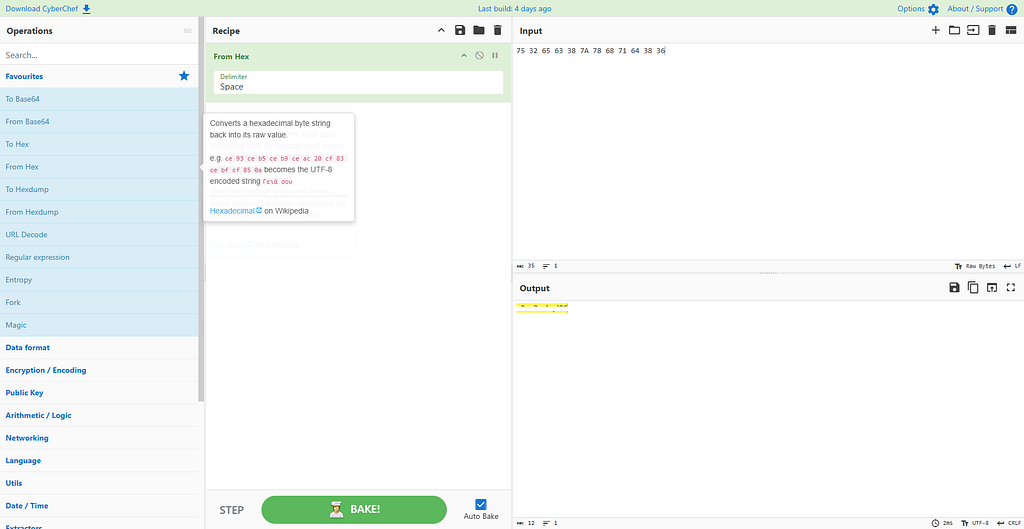
3. Hints and the Geohash solution
The first hint mentioned a method in digital mapping that turns latitude and longitude into a short string. The second hint named the method directly: Geohash ([https://www.geohash.es/](https://www.geohash.es/)).
Decoding the code on a Geohash platform gave the coordinates directly:
- Coordinates: 48.118XX, 16.56XX
4. Result and finding the location
Searching these coordinates on the map led straight to the Flughafen Wien (Vienna International Airport) area in Austria. Since the rules required the place name in the local language (German), I adapted it to the right format and got the flag:
OSINT{***********} (or the exact local place-name format accepted by the room)
Originally published on Medium