How to Identify and Verify Unexploded Ordnance Remotely: Technical Analysis of a Buried 40mm Projectile
Bu çözümün Türkçesi de var: sağ üstten dili TR yapın.
Moving beyond generic media labels and leveraging open-source munition databases to distinguish subtle Soviet-era 40mm grenade variants.
When conducting open source intelligence investigations on unexploded ordnance (UXO), identifying partially buried or weathered munitions is a precise technical challenge. While automated tools and news reports provide an initial entry point, verifying exact designations requires cross-referencing physical markings, fuze geometry, and technical datasheets.
This walkthrough outlines the remote identification process of an explosive remnant partially buried in soil, detailing how to move past broad field terminology to isolate the specific variant.
Initial Assessment and Reverse Image Search
The investigation began with an image of a weathered, cylindrical munition partially embedded in sandy soil, surrounded by brush and debris. The objective was to determine the precise model designation of the partially visible projectile.
To establish the initial investigative trail, a reverse image search was conducted using Google Lens. The search returned matching imagery directly linked to a Ukrainian emergency services (SES) incident report in the Bucha region.
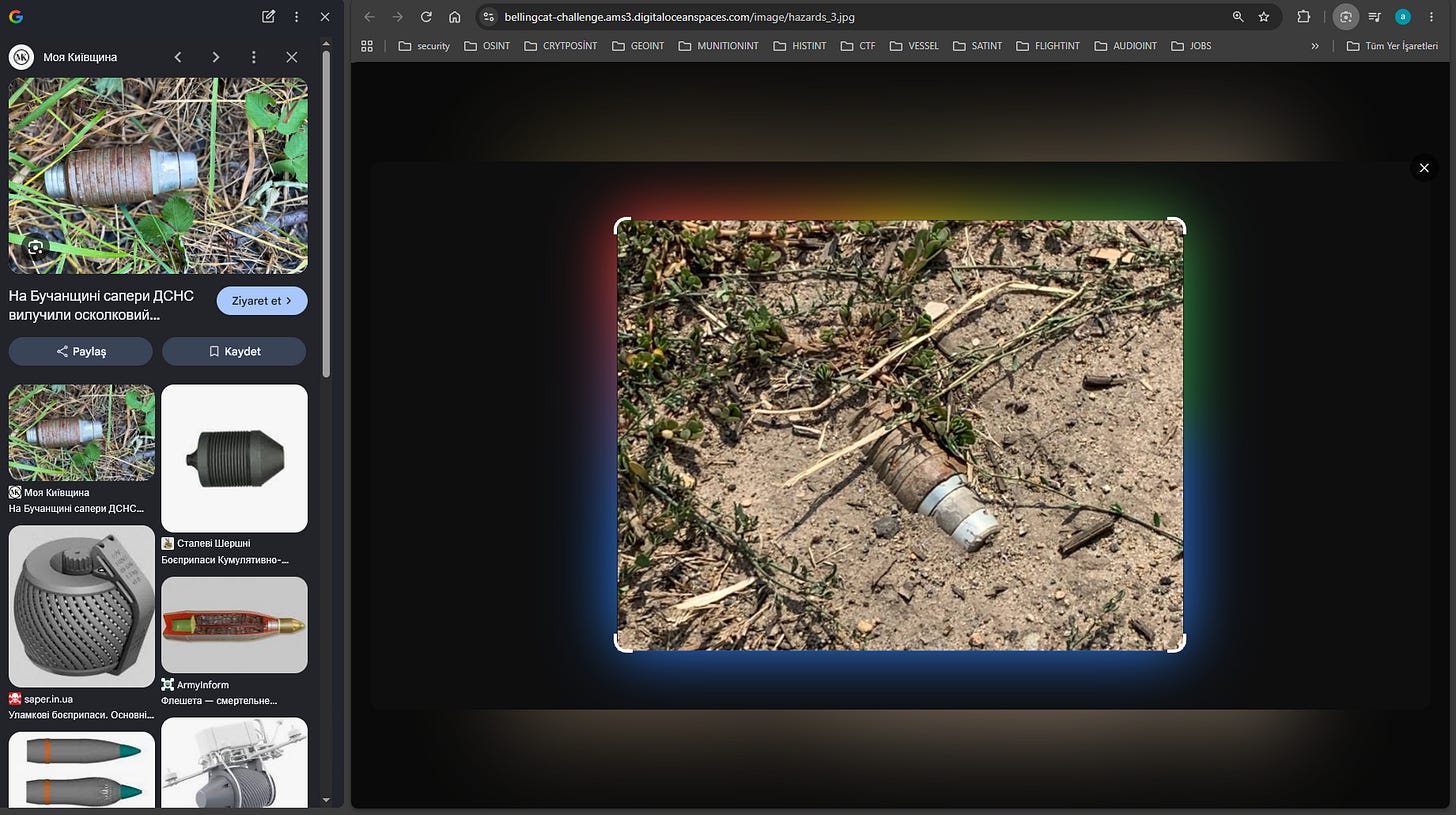
The Boundary of Generic Press Terminology
Examining the Ukrainian news articles reporting on the incident revealed a common label: the munition was described as a standard Soviet/Russian VOG-25 grenade round.
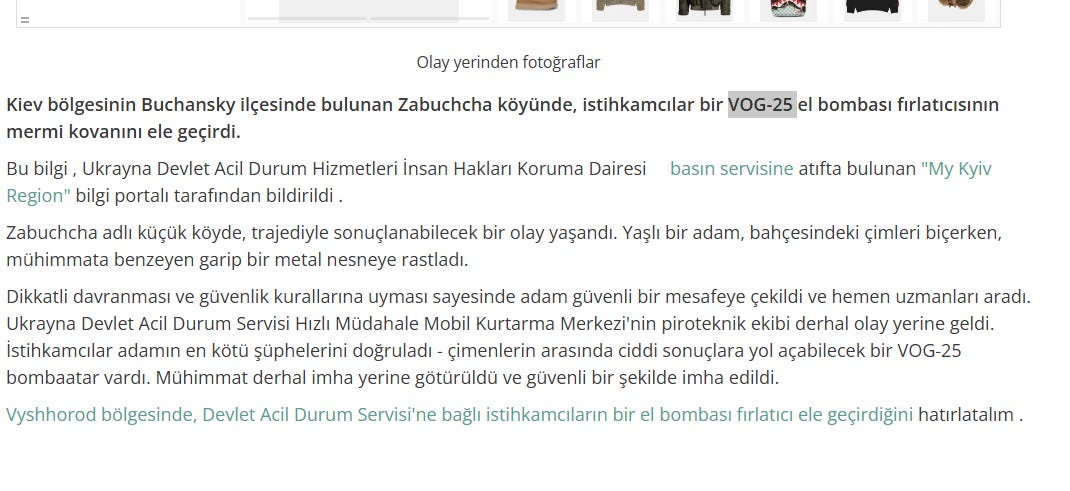
In open source intelligence work, field responders and local media frequently use umbrella designations (such as "VOG-25") to describe an entire lineage of 40mm caseless grenades. Testing "VOG-25" confirmed this limitation, as the platform rejected the entry. The investigation required moving from broad family recognition to variant-level technical verification.
Deep Technical Comparison: Distinguishing the VOG Family
To break down the specific variant, the investigation shifted to specialized explosive ordnance disposal resources, including the CAT-UXO database and technical catalogues from Rosoboronexport.

The Russian 40mm caseless grenade family contains several iterations with specific physical differences:
- VOG-25 (7P17): The baseline High-Explosive Fragmentation (HE-FRAG) round. It has a rounded ogive with an integral point-detonating fuze (VMG-K) and uniform external grooving across the steel body.
- VOG-25P “Podkidysh” (7P24): A bounding/airburst variant. Upon impact, a pyrotechnic charge in the nose ignites, kicking the main projectile body 0.5 to 1.5 meters into the air before airburst detonation. This model is identifiable by a stepped front nose section and distinct pre-engraved rifling bands along the casing.
- VOG-25M & VOG-25PM: Modernized variants equipped with upgraded fuze mechanisms (VMG-P / VMG-PM), optimized fragment geometry, and a modified nose cone and rear sealing band.

The Technical Evidence from the Photo
Even though the base of the projectile was buried, key visual features allowed for isolation:
- The Stepped Fuze Assembly: Unlike the smooth rounded profile of the standard VOG-25, the exposed front of the munition displayed the distinct two-tier collar and cylindrical stepped profile characteristic of the bounding (airburst) mechanism.
- The Body Grooves and Driving Band: The exposed segment clearly showed the machined rifling drive band rather than the continuous spiral ridges of early-generation baseline rounds.
- Variant Verification: While distinguishing a VOG-25P from a modernized VOG-25PM solely from a weathered photograph carries an inherent margin of uncertainty, the specific fuze housing dimensions and modern production markings aligned with the VOG-25PM profile catalogued in recent theater deployments.
Entering the verified designation VOG-25PM successfully solved the case.
Key Takeaways & Safety Notice
- Don’t Stop at the Headline: Media and press releases almost always default to the base name of a weapon family. Rigorous OSINT demands verifying whether an object belongs to a sub-variant or modernized production block.
- Observe Physical Mechanics: Munition variations reflect different operational mechanics (e.g., impact detonation vs. bounding airburst). Identifying physical components like expulsion assemblies or fuze collars narrows the search rapidly.
- Safety Disclaimer: This analysis is intended strictly for remote research and informational purposes. Never approach, disturb, or handle suspected unexploded ordnance in the field. Always report explosive remnants immediately to local authorities and professional EOD services.
Special thanks to the open source investigation community and the methodologies popularized by Bellingcat that continue to inspire systematic verification work.
Connect on LinkedIn: linkedin.com/in/alp-akciğer
Originally published on Substack